

SINGLE-FAMILY MICRO-HOUSING: How To Solve The Housing Crisis
It’s important to look at housing as the industry it is rather than the individual housing unit you call home. While the housing industry is generating revenue for the elite, it is not producing economic stability or contributing to the well-being of citizens. Considering the ongoing national housing crisis resulting from a shortage of financeable single family housing, an alternative means of developing and purchasing single family homes is necessary to remedy this. The average cost of a conventional home in Texas is ~$150 per sqft, with most home developments averaging ~1,400 to 2,500 sqft. WE can live smaller and better with less. Modest manufactured housing can be produced much cheaper and scale to meet demand without wasting precious resources, allowing for a substantial increase in single family housing per acre. Even multi-family housing is not opposed, and can prove sufficient profits when each unit is financed rather than rented. “David Ricardo introduced the term”rent” in economics. It means the payment to a factor of production in excess of what is required to keep that factor in its present use. So, for example, if I am paid $150,000 in my current job but I would stay in that job for $130,000, I am making $20,000 in rent.” Rent is the linchpin that perpetuates poverty and economic instability. Face it, WE need to adopt a new model of housing and community development. For those unprepared to purchase a home, this new model will support homeowners making minimum wage, eliminating barriers to acquire and sell single family housing. By utilizing technology and automation, housing can become the backbone that actually supports this country rather than inflating and crippling it as housing has for over 50 years. By understanding how markets have operated and creating opportunity for them to shift according to supply and demand, we can stabilize the economy and generate “healthy” profit. People like convenience, walkability, and time to enjoy areas their tax dollars contribute to. Businesses prioritize profit and cut costs at the expense of quality. It is the responsibility of businesses and consumers to reprioritize quality among all consumer goods and demand single family micro-housing to produce an adequate supply of financeable housing that promotes economic stability and environmental sustainability. Now let’s look at what the government and housing experts have determined accommodates adequate housing size.
While some legislators and zoning regulations have tried to enforce large minimum building size because it “preserves the character of the neighborhood”, others have determined that “beautiful city residences, homologous lines in architecture and symmetry in construction appeal to artistic tastes . . . and should be respected in connection with substantial zoning regulations for the promotion of the public welfare, but aesthetics alone for the purpose of zoning ordinances do not seem to be a source of police power, according to the weight of authority . . . the zoning ordinance under consideration . . . , on the sole basis of aesthetic standards, does not promote public health, safety, morals or the general welfare, and is therefore void.”
“(Ordinances) having for their purpose regulated municipal development the security of home life, the preservation of a favorable environment in which to rear children . . .the safeguarding of the economic structure upon which the public good depends, the stabilization of the use and value of property . . . are within the proper ambit of the police power . . . The legislative authorities in the city of Huntington Woods are better acquainted with the necessities of their city than we are . . . They are also better able to determine whether the ordinance in question will accomplish the desired end result of stabilizing and preserving property values . . .” “Norman Williams, Jr. presents the other side of the subject in his article, “Minimum Building Size,” which appeared on pages 130-131 of The American City, October 1951. Williams believes that large minimum dwelling size requirements are undemocratic, and in reality “snob” zoning. He feels that the conservation of property values is not in itself sufficient justification for this particular zoning power; others do not.” Quoting Williams’ statement further: “Essentially the same point applies to the arguments about ‘protecting the character of the neighborhood’ and ‘protecting the most appropriate use of land in the area’ – phrases which are sometimes brought up as if they solved all the problems. Such phrases, while satisfactory enough as broad indications of the general purposes of zoning, are too vague and abstract to serve as a satisfactory independent basis for the exercise of police power. For precise and meaningful legal analysis of the basis for excluding certain buildings from an area, it is necessary to be more specific. What characteristics of the neighborhood are referred to? What criteria are to be used in determining whether certain uses of land are appropriate to certain areas? Once these questions are asked . . . we are taken right back to the basic issue of snob zoning. As with the argument about property values, these general phrases cover basic points of policy which may or may not be tenable when stated frankly.” “Williams points out some of the implications of permitting zoning to be used to exclude the less well-to-do groups from a community. It is contrary to all our beliefs concerning taxation and responsibility, he emphasizes, to permit wealthy citizens to live in one community with a low tax rate or a high level of services, while the poorer segments of the population are segregated in another community which, because of the economic level, cannot support even basic municipal services. This objection is particularly relevant in those metropolitan areas where the central city faces a reduction in its tax base as properties in the central city decline and wealthier residents move to surrounding suburban communities. Whether this objection still has validity where both the more exclusive and the less exclusive residential areas are contained within the same taxing jurisdiction is another problem. However, even if the economic reasons against segregation are dismissed, there still remain the social reasons against economic segregation.” To go a bit further, The American City published another article in November 1951, “More on Wayne Township and Minimum-Size Zoning,” by Herbert H. Smith, where he writes: “While I believe that every man should have the right to own a home, I am equally convinced that no public subsidy should be required if he is to have it. The fact remains, however, that very few single-family houses pay their own way, and the majority are subsidized by the tax returns from industrial and commercial property in the community. From the foregoing discussion it will be seen that there is not yet anything like a generally accepted standard for minimum building size, nor is there any clear assurance that the courts will accept minimum building standards. Generally, however, the evidence points to the following conclusions: Minimum building size may be regulated where there is a clear relationship between such standard and health. Such a relationship has not yet been proven conclusively for any minimum dwelling size greater than 600 square feet. Such a relationship is fairly meaningless unless it is related to occupancy standards, i.e. the number of persons occupying the dwelling.”
As determined “by the American Public Health Association, Inc., New York, minimum space standards are enumerated as follows: “Every dwelling unit shall contain at least 150 square feet of floor space for the first occupant thereof, and at least 100 additional square feet of floor space for each additional occupant thereof, the floor space to be calculated on the basis of total habitable room area. In every dwelling unit of two or more rooms, every room occupied for sleeping purposes by one occupant shall contain at least 70 square feet of floor space, and every room occupied for sleeping purposes by more than one occupant shall contain at least 50 square feet of floor space for each occupant thereof. Thus, according to these standards, a minimum building size requirement in excess of four hundred square feet may be imposed according to family size. For a family of six, it would be possible under this regulation to require a minimum building size of six hundred and fifty square feet. It is interesting to compare the minimum building sizes which the Committee felt to be enforceable by law with the minima suggested in their volume of standards, Planning the Home Occupancy. This was published by Public Administration Service in Chicago in 1950. In this volume, the Committee on the Hygiene of Housing dealt not with enforceable minima, but with “desirable” minima. In the words of the Committee: The proposed standards are not suggested for legal condemnation proceedings, but represent minimum requirements for satisfactory housing. They should be clearly distinguished from the detailed regulation which must be embodied in the building code . . . . These figures are not suggested as standards to be applied by legal means, but are goals at which to aim. They represent the essential space requirements of the dwelling which, without extravagance, will make physical and emotional health possible.”
Lastly, “the standards promulgated by the Federal Housing Administration to which buildings must conform in order to be eligible for FHA loans is fairly clear. Such requirements would permit dwellings of even less than 400 square feet (i.e., 350 square feet) without violation of the regulations.”
First Steps To Solving the Housing Crisis
We live and pay in excess for who’s “American Dream”? Wasted space is not satisfying or “aesthetically’ appealing, and in fact puts undo stress on personal finances, as well as the economy and the environment for EVERYONE. City governments and businesses need to compromise, pivot, and work together to provide alternative means of developing adequate single family housing (similar to the 1920s without inflation) to regain “liberty” for “ALL”. “We the People” have to demand fair housing by changing and/or utilizing existing legislation. There are two options for gaining legislative approval of single family micro-housing: One, update existing city legislation and zoning regulation to allow for the development of single family “micro-housing” starting at ~600 sqft (but potentially as small as 150 sqft for one occupant dwellings, with 100 additional sqft for each additional occupant as determined “satisfactory” by the American Public Health Association). Without readily available undeveloped tracts of land in the city, this approach will be met with a lot of resistance as certain communities will have to vote together to allow for the demolition or deconstruction of existing single family houses or other structures to clear space for new single family micro-housing developments. Alternatively, existing single family home properties can be rezoned to allow for the building of additional dwellings on the lot. To avoid sporadic, inconsistent, devaluing “grandmother” cottages in backyards, some communities made up of single family houses can rezone the area to allow residents to split their property and sell half of the lot to be used for the construction of two new micro-houses. This can be done complementary to existing single family homes to retain “character” and “aesthetic” appeal while allowing for double the volume of single family housing per street. With this approach, Municipalities would be best off to segment specific areas of the community that can be expected to fully adopt micro-housing to replace older, larger single family homes. Done “responsibly”, these older single family homes can be deconstructed to reuse materials and create job opportunities in the community. Option two, as the State of Texas allows, is to have at least 10% of qualified voter residents of the community file a petition with the county judge to form a Type A, B, or C General Law, Special Law, or Home-Rule Municipality (which formed the Town of Sunnyvale as a Home-Rule Municipality in Dallas County, Texas). The petition must request the county judge to order an election to determine whether the community will incorporate as a designated Municipality. If approved, the community may incorporate as a city, town, or village with a minimum of 201 residents. If under 2,000 residents, the community must not cover more than two square miles of surface area (no more than four square miles for 2,001 to 4,999 residents, and no more than nine square miles for 5,001 to 9,999 residents). This empowers the residents (or community-elected officials) to take ownership of legislation and create zoning regulation that supports the development of single family micro-housing and other small housing options. This also allows the “Township” to restrict homeowners from renting their single family houses, and prevent the development of rental apartment complexes within its boundary. Ultimately, any 201 qualified voters can form a Municipality as a city, town or village in any area no greater than two square miles. While it may be easiest to coordinate the purchase of land in a less developed area and build up a “Township” from “scratch”, it is feasible to do so in major cities whether land-locked or not. Considering many have grown accustom to amenities that city-living offers, a large portion of people may not want to leave all the conveniences. However, more accommodating amenities can be funded with the development of an entirely new “Township”. Building a “Township” from the ground up will take time, patience, and some compromise, but you will likely get more out of life with less.
The Current Market for Housing Development
Let’s focus on North Texas since many of its cities have seen the fastest population growth in the United States since 2010. For example, Denton grew “by more than 50,000 people between 2008 and 2015 – an increase of nearly 63%”, and the population is expected to reach ~300,000 residents by 2030 (with average household income at $100,000 and over 59,000 college students). Denton has been voted most livable city in Texas, number one small town and number six high-tech hotspots in the United States. And while Denton projects so much promise, it is dominated, like most other major cities, by rent. Just a few miles south of Denton is the City of Argyle, which has seen a bulk of the single family houses developed in North Texas over recent years (all in excess of $300,000 and oversized). Argyle also has a snazzy local business “park” with “local” coffee and restaurants. Driving distance from Denton and Argyle, there are a variety of well-designed rent-funded communities throughout the DFW metroplex offering mixed-use areas that are walkable with plenty of “entertainment”. There’s Lakeside in Flower Mound with luxury homes and a large quantity of rental apartments adjoined by a craft beer bar, restaurants, a small grocery market, and movie theatre, all connected to paved but mostly dirt trails on Grapevine Lake. Billingsley is one of the largest developers in DFW. They own a majority of the major undeveloped plots of land in DFW and specialize in mixed-use developments. Austin Ranch is their primary development spanning 1,700 acres. It is a master-planned community with rental apartments, luxury homes, retail, and corporate campuses. They connect to Arbor Hills Nature Preserve with dirt and paved trails. The Boathouse is one of their newer luxury apartment complexes with a modern gym, luxury pools, walking trail, and co-working areas that complement modern living. Across the street is “The Shacks”, a dog park with local dining, coffee, and craft beer in a patio setting offering a great experience for everyone. Right down the street connected by trail is Grand Scape, a mixed-use development off the tollway that offers a variety of additional restaurants, bars, and retail options (including Nebraska Furniture Mart).
Some other multi-use developments in DFW include Legacy and Legacy West in Plano, City Line in Richardson, Old Town Lewisville, Southlake Town Square, Old Town Carrolton, Old Town Grapevine, Old Town Coppell, Linwood in Fort Worth, and Rayzor Ranch Town Center in Denton.
Land Ownership
While these luxurious mixed-use rental communities account for a substantial portion of the housing developed in North Texas over recent years, they come at the loss of land ownership for the majority of residents with respect to housing units. The United States was founded as a country where resident land ownership was encouraged as the primary means of economic wealth. “Never in human history, before or since, has authority gone to such lengths to help the common people to become landowners. … the Public Land Commission set up by Theodore Roosevelt argued that the 1862 Act and its successors had achieved many of its objectives: ‘It protects the government, it fills the state with homes, it builds up communities and lessens the chance of social and civil disorder by giving ownership of the soil, in small tracts, to the occupants thereof.” While much of the reasoning behind the government selling off so much land was to support westward expansion, the “Frontier” has long-since been acquired. Of course, anyone can buy land in the middle of nowhere or in a small town with extremely limited work, education, and interactive opportunity, but “we the people” do not deserve to forego “community” and modern amenities just to own land in a city or county that does not suit us, commuting hours just to own a roof over our head and keep food on the table in isolation. The government has forced this by shifting its priority to passive income in the form of credit interest, rental apartments (as “affordable housing”), health insurance, title insurance, and subsidies to funnel land and money out of circulation and into deep “elite” pockets. Metropolitan cities are not overpopulated, they are underdeveloped because of excessive, oversized housing. The solution is simple – city legislation and zoning must change to support micro-housing development so we can achieve “liberty and justice for ALL”.
Solve the Housing Crisis With Single Family “Micro-Housing”
Purchasing a home is the largest investment most people make in their entire life, and should always provide the foundation by which we build wealth as a “family unit” and as a nation. North Texas has seen substantial economic growth over the last decade, but for who? How secure is a $300,000 home on two minimum wage incomes, especially when one loses their job? Does anyone, or any family, need 1,500 to 2,500 sqft to live a happy and healthy life? No.
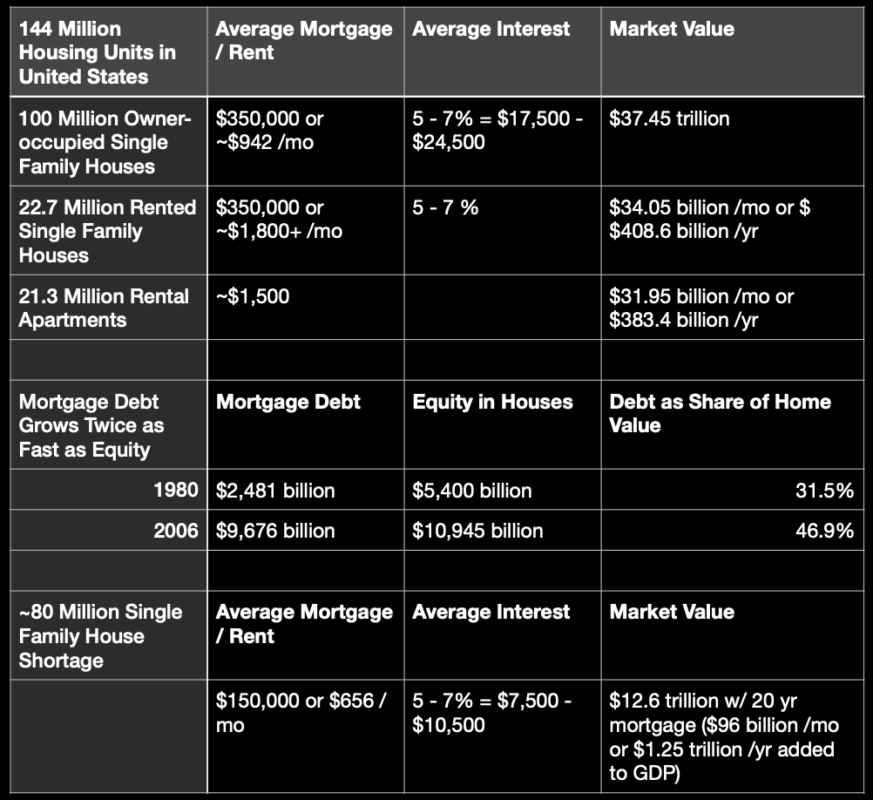
The mass shortage of affordable single family homes (not “affordable housing”, which is a term fabricated by the government to support the “passive income” produced by rental apartment developments) has left United States citizens stagnant, with home buying and development limited mostly to the top 20% of the population. Our objective as a nation should not be to increase dependence on government welfare, subsidies, and social security to maintain a roof over our heads – this reduces economic stability in totality (but it’s made our government very powerful as an oligarchy). Learning from their parents financial and resulting relational struggles before, and almost certainly after, the 2008 housing crash, millennials and younger generations have been hindered from purchasing a home, and therefore, accumulating wealth. They’ve been forced to wait out their 20s in hopes of change by their 30s, with many in their 40s still throwing money away every month on rent waiting for the opportunity to build wealth through home “ownership”. The real estate market has little appeal, and with the rise of shows like “Fixer Upper”, standards have only gotten higher. The few older homes that are available to purchase are in need of repair and remodeling, which most don’t possess the capital, skills, or tools to remodel an older home (even if they have the time). Yes, younger generations are notorious for having unrealistic expectations, but the shortage of adequate single family housing is undeniable.
Manufactured Single Family Housing Options
There’s a number of options to address the shortage of housing that don’t involve living on wheels in an eight and a half foot wide “tiny house”. We can utilize technology and automation wherever beneficial to meet the demand that has existed for over half a century. We don’t need to reinvent the wheel, it was mostly refined ~100 years ago. Manufactured housing is better suited to withstand the harshest of scenarios (such as earthquakes, hurricanes, and tornados). And there is far less waste and pollution with or without LEED certified practices.
Alternative methods of building modern single family housing:
- Prefabricated steel frame housing combined with:
- Manufactured wood and/or hemp paneled housing
- Hempcrete brick housing
- 3D printed housing
Note, hemp is the primary material that can supplement wood in the home building and furnishing process. Hemp hurd can be manufactured into paneling of equal strength to wood which can be used to build cabinetry and furniture. The importance this has on our agriculture and housing industries cannot be overstated. Hemp farming is OUR guaranteed path to economic and ecological prosperity.
With many of these home building options offered by multiple businesses, specifically in Texas but also other states, it’s unfortunate that Texas cities have not changed legislation so that residents can take advantage of more affordable, quality housing options. Seems conservatives are only conservative when it adds to their wealth, and more so, influence. “Manufactured” housing allows for increased precision, efficiency, and scalability. Traditional stick built housing simply can’t compete (and never could). It’s time WE adapt and demand sustainable housing that scales for the good of ALL.
Sign our petition for single family “micro-housing”. Register your city and largest metroplex nearest to you. Upon reaching an adequate number of qualified voter registrants, HomeTown Investments will submit a petition for each community to incorporate as a Municipality or gain legislative approval of single family “micro-housing” in your community.